

Becoming a licensed esthetician follows a defined path. Each state sets its own hour requirements, exam format, and application rules, but the process works the same way whether you’re in Illinois or Indiana.
Knowing exactly what each step requires before you enroll is what keeps you from choosing the wrong program or missing a requirement that delays your license.
Step 1: Research Your State’s Requirements
Before you enroll in anything, confirm what your state requires, because the program you choose has to match those requirements or your training hours won’t count toward your license.
State requirements typically cover four things: minimum clock hours, exam format, minimum age, and education prerequisites. Clock hours matter most. They determine how long your program runs and what you’ll be doing during it. In Illinois, 750 of those hours are split between theory instruction and hands-on lab work.
Theory covers skin science, product chemistry, and safety protocols. Lab time is where you practice techniques on real skin. Indiana requires 700 hours on the same split model.
Here’s how the two states compare in 2026.


| Requirement | Illinois | Indiana |
|---|---|---|
| Minimum training hours | 750 hours | 700 hours |
| Exam format | Written only | Written and practical (Practical is given at the school level) |
| Minimum age | 16 | 18 |
| Education minimum | 8th grade or equivalent | 10th grade or equivalent |
Indiana students take both a written and a practical exam given by the school, so their lab hours carry additional weight. Whatever techniques you practice during training are the ones you’ll be evaluated on at the state board. Your program needs to prepare you for that specific format.
In Illinois, your license renews every two years with 10 continuing education (CE) hours required each cycle. Knowing the renewal requirements upfront helps you plan for the long-term cost of maintaining your license.
Step 2: Choose a State-Approved Training Program
The school you choose must be approved by your state’s licensing board. Graduating from an unapproved program means you cannot sit for the licensing exam, regardless of how many hours you completed. That’s the floor. Everything else is where programs separate themselves.
When comparing programs, look at these factors.
- The program needs to meet your state’s clock hour minimum. One that exceeds it gives you more lab time before you test.
- The curriculum should go beyond basic facials. Look for chemical exfoliation, dermaplaning, advanced extractions, hair removal, body treatments, and makeup artistry alongside the required skin science and sanitation coursework.
- Find out what brands and equipment students train on. Learning on professional-grade tools and industry brands means you’re job-ready on day one, not catching up once you’re hired.
- Structured real-client experience matters. Model Days, clinic days, and similar programs build your technique and your confidence before you test.
- Flexible scheduling and financial aid eligibility affect whether the program is actually accessible to you. Not all programs qualify for federal aid.
Named AACS Golden School of the Year in both 2022 and 2023, Tricoci University of Beauty Culture’s® (Tricoci’s) Esthetics program trains students on professional brands including Dermalogica, SkinScript, Bio-Therapeutics, and many more. It also covers a broad range of advanced skills such as:
- LED light therapy
- Nanoinfusion
- Ultrasound skin tightening
- Microcurrent facial toning and more
Step 3: Complete the Program
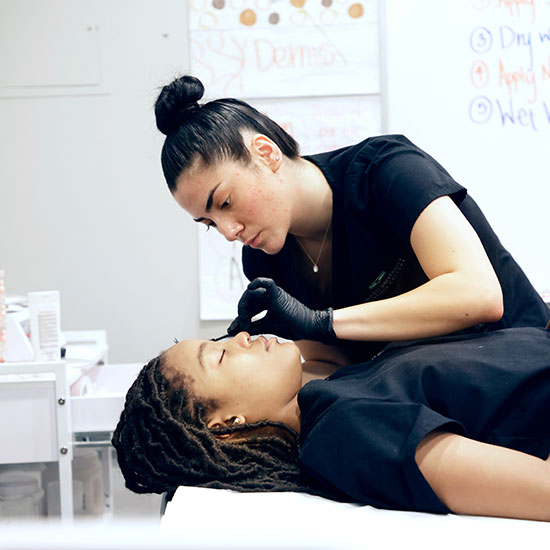
Clock hours are split between classroom instruction and supervised clinic work. Classroom time covers skin anatomy, product chemistry, and the science behind why treatments work. Clinic hours are where you apply it on real clients, under instructor supervision. Both count toward your state’s required total.
A standard esthetics curriculum covers:
- Skin anatomy, physiology, and conditions
- Customized facial treatments and skin analysis
- Chemical exfoliation and peels
- Dermaplaning and microdermabrasion
- Hair removal techniques
- Body treatments
- Sanitation, disinfection, and infection control
- Client consultation and treatment planning
- Makeup artistry
- Retail and business fundamentals
Informal skincare experience teaches you how to perform services. School teaches you how to perform them safely, legally, and as a business. Sanitation and infection control are state-mandated requirements. They aren’t optional, and a strong program treats them that way.
| Schedule | Estimated Completion |
|---|---|
| Full-time | Approximately 5 months |
| Part-time | Approximately 9 months |
Step 4: Pass the Licensing Exam
After completing your required clock hours, you sit for your state’s licensing exam. The format depends on where you’re licensed.
- Illinois requires a written exam only. There is no practical component.
- Indiana requires both a written exam and a practical exam. The final practical exam is given by the school.
If you’re in Indiana, your clinic hours carry extra weight. You’ll be demonstrating technique on exam day, so the quality of your hands-on training matters as much as your written preparation.
Some states allow students to test before completing all required hours but withhold the license until the full requirement is met. Check your state board’s current policy before you schedule your exam date.
Step 5: Apply for Your License
Passing the exam doesn’t automatically issue your license. You need to submit a formal application to your state licensing board with proof of completed training hours, exam results, and the required fee.
Once your application is approved and you receive your state license, you can legally work as a licensed esthetician. Career paths available with your license include:
- Day spas and resort spas
- Salons (standalone or chain)
- Medical spas and dermatology clinics
- Freelance or mobile esthetics
- Your own business or rented suite
Most estheticians start in a salon or spa to build a client base. Self-employment is an option from day one, but a book of business makes that move significantly easier.
Still weighing whether the career is the right fit? Speak with a team member!
Step 6: Plan for Renewal from Day One
Your state sets the renewal schedule, and in Illinois that means every two years with 10 CE hours per cycle. The CE requirement isn’t just a box to check. The courses available to licensed estheticians regularly cover techniques that expand your service menu and what you can charge for them.
| Renewal detail | Illinois |
|---|---|
| Renewal cycle | Every 2 years |
| CE hours required | 10 hours per cycle |
| Renewal fee | $50 |
Ready to Get Started?
If you’re serious about turning skincare into a career, the next step is finding a program that sets you up to pass your exam and walk into a job ready to work. Tricoci University’s Esthetics program offers flexible scheduling, professional brand training, and clinical-grade technology included in tuition.
Request info to connect with a team member.
Frequently Asked Questions
Do I need experience to enroll in an esthetics program?
No prior experience is required. Esthetics programs build skills from the ground up. Students who already have informal skincare knowledge tend to move through foundational material quickly, but experience is not a requirement for admission.
Can I become an esthetician if I’m still in high school?
In Illinois, you can enroll in an esthetics program at age 16, but you must already hold a high school diploma or its equivalent to get licensed. Indiana has stricter requirements, requiring applicants to be at least 18 years old. If you’re a high school student looking to explore the industry early, Tricoci University offers Tricoci Forward program. This 3-day introductory workshop and beauty camp is designed to give you a hands-on feel for the career.
How much does esthetics school cost, and is financial aid available?
Tricoci University’s Esthetics program is FAFSA-eligible. Scholarships and grants are also available. Visit the financial aid and affordability page for current program costs and aid options.
What’s the difference between an esthetician and a cosmetologist?
Estheticians specialize in skincare. Their scope of practice covers facials, chemical peels, waxing, lash services, and skin analysis. Cosmetologists cover a broader range of services including hair cutting, color, and chemical treatments, and their programs require more training hours. The licenses are separate. Most people choose based on which services they actually want to perform.
For a more in-depth comparison, check out our previous post, Cosmetology vs. Esthetics.
Can I work for myself as an esthetician?
Yes, a licensed esthetician can rent booth space, lease a private suite, or open a business. Most estheticians build a client base in a salon or spa first, then move toward self-employment once they have a book of business to take with them.